5 Signs It's Time to Replace Your Concrete Driveway in Plantation, FL
Your driveway takes a beating every single day — Florida heat, afternoon downpours, and constant vehicle traffic. At some point, no amount of patching will fix what time and the elements have done. If your driveway has been looking rough lately, this guide will help you figure out whether you're dealing with a normal repair situation or a full replacement — and what that means for your home and budget.
3/13/20264 min read
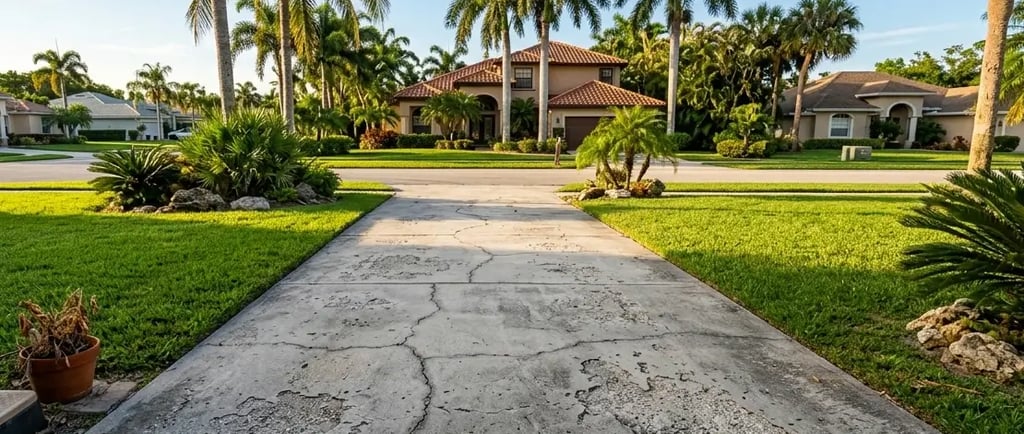
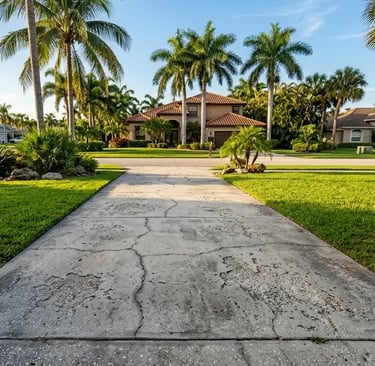
Quick takeaway: Most concrete driveways last 25–30 years — but Florida's heat, humidity, and heavy rain can speed up wear. Knowing the warning signs early can save you from costly repairs down the road and protect your property's value.
Your driveway does more work than it gets credit for. Day after day, it supports vehicle traffic, bakes under the South Florida sun, and holds up through afternoon thunderstorms without complaint. But like everything, concrete has a lifespan — and there comes a point when patching cracks just isn't enough anymore.
At Plantation Concrete Services, we work with homeowners across Broward County who've been putting off this decision for years. More often than not, they're relieved once they understand what they're actually dealing with — and how straightforward a quality replacement can be.
Here are the five clearest signs that your driveway is ready for a fresh start.
1. Cracks That Keep Coming Back
One or two hairline cracks on a new driveway? That's normal concrete behavior as it settles and adjusts to temperature changes. But if you're patching the same spots season after season — or noticing cracks wider than a quarter-inch — the slab itself has structurally weakened.
In Plantation and across Broward County, tree roots, shifting soil, and Florida's wet-dry seasonal cycles are the main reasons cracks keep returning. When the ground beneath your slab moves repeatedly, the surface can't hold a repair permanently.
💡 Quick test: Slide a quarter into a crack — if it fits, the crack is wide enough to allow water infiltration, which will cause the damage to worsen quickly in Florida's rainy season.
When repair is enough vs. when to replace:
Repair: Isolated crack under ½ inch wide, slab is otherwise level and solid
Replace: Network of cracks spreading across multiple sections, or cracks with vertical displacement
2. Sunken or Uneven Sections
When part of your driveway sinks lower than the rest, it's a sign that the base layer underneath — called the subbase — has shifted, eroded, or was improperly prepared in the first place. This creates trip hazards for your family, guests, and anyone walking to your front door.
Uneven sections also collect standing water, which makes the problem worse over time. Water infiltrates, softens the soil further, and the cycle continues. In many cases, mudjacking (a technique to lift sunken slabs) can offer a temporary fix, but if the underlying soil issue isn't resolved, the problem will return.
A proper replacement done by an experienced local contractor includes compacting the base correctly the first time — which is what makes the difference between a driveway that lasts 10 years and one that lasts 30.
3. Surface Deterioration and Spalling
Spalling is what happens when the surface layer of concrete begins to chip, flake, or pit — revealing a rough, crumbling texture underneath. It can start as cosmetic roughness, but it progresses quickly once moisture gets into the exposed aggregate.
In Florida's climate, UV exposure and repeated wetting and drying accelerate surface breakdown faster than in cooler states. If your driveway looks like it's peeling or has patches of rough, sandy texture where it used to be smooth, spalling has set in.
Resurfacing can sometimes address mild spalling, but once it covers a significant portion of the slab or has penetrated deeper than the surface, replacement is the more cost-effective long-term option.
4. Drainage Problems That Aren't Getting Better
A well-designed driveway has a subtle slope that guides rainwater away from your home and off the surface. Over time, settling and wear can alter that slope, leading to puddles that sit for hours — or worse, water that channels toward your garage or foundation.
Broward County's rainy season (typically June through October) puts enormous strain on drainage. If you're regularly seeing pooling water on your driveway, especially near the garage, it's worth having a professional evaluate whether the slope can be corrected or whether the slab needs to be re-poured with proper grading.
Why this matters beyond the driveway: Poor driveway drainage can contribute to moisture intrusion in your garage floor, foundation cracking, and mold growth — all significantly more expensive to fix than a driveway replacement.
5. The Driveway Is Simply Too Old
If your home was built in the 1980s or 1990s and has its original driveway, there's a strong chance it's approaching — or already past — its expected lifespan. Concrete slabs typically last between 25 and 35 years under normal conditions, but South Florida's climate puts added stress on materials year-round.
An older driveway may look passable on the surface while hiding deeper issues: rebar corrosion, base erosion from years of rainfall, or stress fractures not yet visible from above. At some point, the cost of ongoing repairs adds up to more than a replacement would have cost — without giving you the clean, durable surface a new slab provides.
If your driveway is over 20 years old, a simple assessment by a qualified concrete contractor can tell you where it stands — and whether you're still getting value from what's there.
What to Expect From a Concrete Driveway Replacement in Plantation, FL
A concrete driveway replacement typically involves removing the existing slab, properly grading and compacting the base, and pouring a new slab with the right mix, reinforcement, and finish for your home's needs. The process usually takes 2–4 days from demo to pour, with a curing period before full vehicle use.
Here's what a quality job includes:
Proper base preparation — compacted gravel or shell base to prevent future settling
Reinforcement — rebar or wire mesh to add tensile strength
Control joints — strategically cut to direct where the concrete naturally expands and contracts
Finish options — broom finish, exposed aggregate, or decorative stamped patterns
Sealing — a quality sealer applied after curing extends lifespan and enhances appearance
Homeowners often use a driveway replacement as an opportunity to upgrade — widening the driveway for a second vehicle, adding a decorative border, or transitioning to a stamped concrete design that complements the home's exterior.
Ready for a Driveway That Looks Great and Lasts?
Get a free quote from Plantation's most trusted local concrete contractor- Plantation Concrete Services. We serve all of Broward County.
Plantation Concrete Services - Your trusted concrete contractor in Plantation, FL. Specializing in residential driveways, patios, commercial parking lots, and decorative concrete solutions. Committed to quality craftsmanship. Serving Plantation and all Broward County communities with professional concrete services you can trust.
(954) 371-2391
info@plantationconcreteservices.com
© 2025. All rights reserved.
Monday to Friday | 7:00am - 5:00pm
Saturday | 8:00am - 4:00pm
Plantation, Florida
ABOUT